Kawaii Sushi Cat Icon Pack
First Stitch, First Impression: Playful—but Precise
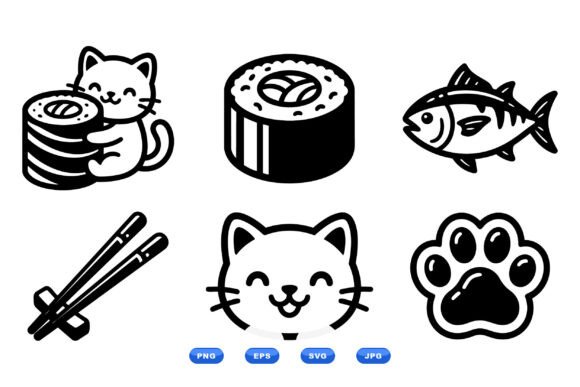
Opening the Kawaii Sushi Cat Icon Pack feels like unboxing a tiny, joyful secret—cats curled around sushi rolls, paws clutching chopsticks, fish motifs with blushing cheeks. As an embroidery designer who’s stitched everything from nursery quilts to boutique aprons, I immediately scanned for what matters most in real-world use: clean lines, intentional negative space, and scalability. These are line art icons—not dense illustrations—so they breathe well on fabric. That’s promising. But line art only works if the strokes hold up under thread. I tested one icon—a cat hugging a salmon roll—as a 3.5" embroidered motif on a linen-cotton tea towel. The result? Crisp, charming, and unmistakably handmade—not cartoonish or pixelated. That balance is rare.
Where This Pack Truly Shines (and Where It Needs Caution)
The Kawaii Sushi Cat Icon Pack isn’t built for photorealism—it’s built for personality. That makes it ideal for products where warmth and whimsy drive buyer connection: custom embroidered tote bags for a local ramen shop, baby onesies with a single paw-and-fish icon, or kitchen towels sold at craft fairs. I used the chopstick-holding cat on a lightweight organic cotton sweatshirt—hooped with medium tear-away stabilizer—and it stitched cleanly at 4" wide. No skipped stitches, no thread nesting. Why? Because the design avoids ultra-thin connectors, tight corners, or overlapping outlines that trip up machine embroidery.
But here’s where judgment matters: this pack leans into simplicity, not versatility. On dark fabrics, fine line details can fade unless you boost thread contrast—try navy thread on black denim, not ecru. On stretchy knits (like toddler tees), skip the smallest icons (<2") unless you add cutaway stabilizer underneath. And curved surfaces—caps or rounded pillow covers—demand careful placement: the sushi-roll cat’s round shape adapts well; the chopstick icon’s straight elements risk distortion near seams or crowns. Also, avoid using the full set as a dense border on a holiday pillow cover—the icons weren’t designed for tight repetition, and stitch density could overwhelm the fabric.
A Real Project Check-In: Embroidering for a Pop-Up Bakery
Last month, I helped a friend launch “Mochi & Miso,” a small-batch Japanese-inspired bakery. She needed embroidered aprons, takeout totes, and gift tags—all with consistent, friendly branding. We chose the Kawaii Sushi Cat Icon Pack for its food-meets-charm alignment. The fish + paw print combo became her logo stamp on twill aprons (3.2" wide, satin-stitched outline with soft fill). The cat-hugging-sushi icon went onto cotton-linen totes—stitched at 4.5", it read clearly from across the market stall. Customers smiled, snapped photos, asked where we got the design. That’s the quiet power of this pack: it doesn’t shout—it invites. It feels handmade, not mass-produced, which builds trust with buyers of small-shop products.
That said, I advised against using the smallest PNGs (under 1000px) as direct embroidery files. They’re perfect for digital mockups or web stickers—but for actual stitching, SVG files gave us cleaner vector paths to convert into smooth embroidery files. Always run a test stitch on scrap fabric first, especially when layering icons (e.g., stacking the paw print beneath the cat). Overlapping areas need stitch-density checks to prevent puckering.
Design Integrity Meets Commercial Reality
As an Etsy seller and embroidery educator, I watch how design choices ripple through customer perception. A cluttered, over-digitized icon reads as cheap. A vague, low-contrast motif reads as unfinished. The Kawaii Sushi Cat Icon Pack lands in the sweet spot: bold enough to scale, delicate enough to feel intentional. It elevates a plain tote bag into a personalized gift. It gives a baby bib quiet storytelling—not just decoration. And because it’s rooted in kawaii aesthetics (soft curves, gentle proportions), it avoids cultural missteps common in food-themed graphics—no caricatures, no forced “cute aggression.” Just cats, sushi, and sincerity.
For craft business owners: this pack supports brand consistency without demanding rigid uniformity. Use one icon per product, or mix two (e.g., fish + chopsticks) for a subtle pattern repeat on tea towels. For commercial embroidery projects, confirm licensing covers finished goods—you’re selling the embroidered item, not the file itself. Since the ZIP includes SVG and PNG formats, it’s flexible for both physical stitching and digital product previews (think printable mockups for your Etsy listings).
Practical Notes Every Embroiderer Should Run Through
- Test first: Stitch one icon on your target fabric + stabilizer combo before committing to 50 aprons.
- Check contrast: View your thread colors against light and dark fabric backgrounds—some pastel threads vanish on heather grey.
- Review stitch density: High-fill areas (like solid sushi rolls) may need reduced density on lightweight fabrics to avoid stiffness.
- Confirm hoop size: Most icons scale cleanly between 2.5"–5", but verify your machine’s max hoop capacity matches your intended layout.
- Inspect small details: The tiny fish eye or chopstick tip should remain legible at your smallest intended size—zoom in on your embroidery software.
- Try black-and-white mockups: If your design relies on color contrast, test grayscale versions to ensure shape recognition stays strong.
- Match stabilizer to fabric texture: Linen? Use medium cutaway. Terry cloth? Add topping. Don’t assume one stabilizer fits all.
- Verify usage rights: Since this is categorized as Illustrations and Graphics, double-check whether commercial resale of finished embroidered items is permitted.
Final Thought: Charm With Craftsmanship
The Kawaii Sushi Cat Icon Pack won’t replace complex applique designs or photorealistic portraits—and it’s not meant to. What it does exceptionally well is deliver joyful, stitch-ready charm with zero visual noise. It respects the embroidery process instead of fighting it. Whether you’re stitching a one-of-a-kind holiday gift or building a cohesive line of small-shop merchandise, this pack adds personality without compromising polish. In a world of generic clipart, that’s not just practical—it’s quietly professional.